A place to share thoughts, ideas, gadgets, and giggles from my classroom. 💜

Google Forms: Digging Deeper


     As I was navigating remote learning, one Google App I consistently forgot about was {Google Forms}. Forms can be such a valuable tool, but I couldn't think of a way to use it...so I did a deep dive (Office Ladies reference anyone?) and found so many useful ways to incorporate Forms into the traditional and virtual classroom. 
     I found 3 great ways that were simple to add into the curriculum: quizzes, a choose your own adventure, and an escape room. As a Certified Google Trainer, I am very familiar with the how these functions and activities are designed and work, but many others don't. I created a training to help others discover Google Forms and how it works. 


My trainings are so very different than the regular ones you have seen and been through. Mine are interactive and exploratory. As you work through the challenges, you will come out with three useable activities! I challenge you to play with the buttons, use the tools, and solve your problems as they arise. I don't just throw you into the pool though. 
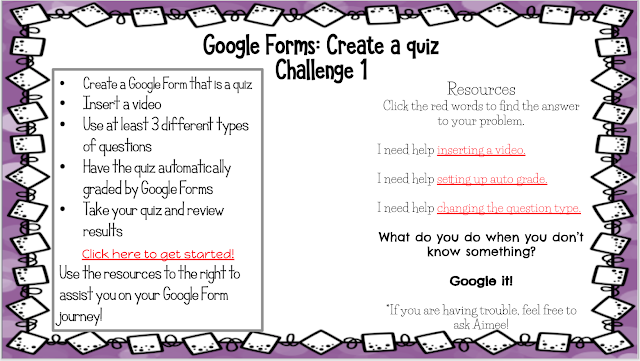
I walk you through each step involved for the challenge. I give you a criteria for each challenge and links to videos of me doing each of those steps if you run into trouble. The challenges get increasingly more difficult and do require some preplanning. You can work at your own pace and you get a 2 hour Professional Development certificate at the end. 
If you are ready to dig deeper into Google Forms, head this way! {Google Forms: Digging Deeper}


Spring Time Safety Tips

     Warm weather is on the way...finally! I love when the groundhog does a good job. With spring comes outside playing, fun activities, end of the year prep (YES!!!), and stormy weather. I love to discuss how to stay safe while in the sunshine or bad weather. Here are my top 3 talking points when discussing spring time safety with my students.

1. Tornado Safety
"In like a lion" sometimes takes on a real meaning! Just last week my students had to be in our tornado safe place for 2 hours... When warmer weather starts to appear, I want to
1. Make sure my students are prepared for bad weather.
and
2. Help them understand what is happening, the science behind the tornados/stormy weather so it will help take some of the fear out of the storm.
I am one of those people who hear about a tornado and run right outside to see it!
My husband is just the opposite, so I have him take the dog to safety too. When discussing tornados, my favorite book to read is {Super Storms by Seymour Simon}. 
Then we dig into tornado vocabulary, then discuss how a tornado forms. 
Then we talk about how to stay safe during a tornado. Students then make their own tornado safety plan. I really like to make this a family project so familes kind of HAVE to talk about tornado safety. I can remember my mom telling me allll our safety plans and 12 year old me would just roll my eyes, totally annoyed. But I can still tell you where our meeting place is for a fire and what to do at my Mom's for a tornado! I think kids need to know where to go and what to do for multiple locations...school, Grandparents', the car, Wal-Mart...because let's be real, tornado's are scary and kids need to be prepared! 
You can find all this and a science experiement in my {Tornado Mini-Unit}

2. Playground/Park Safety
As the weather warms, kids love to go outside and play. In this day and age, many parents don't mind taking their kids to the park or a playground, but they also take their phones. I see so many people just scrolling through whatever while their kids are playing. If something were to happen, kids need to be aware. I always remind my students:

1. Don't talk to strangers- Pretty basic I know, but with all the creepy stuff happening with people watching and taking kids, a park would be easy. Kids need to know that if a stranger is approching them, they need to go to their adult, just to be on the safe side.

2. If you see something sharp on the ground, tell an adult you trust right away.-Some parks are not as clean as others. Better safe than sorry!

3. If you can't see your adult, they can't see you.- This is a good rule for more than just the park! My mom always told me to "Stay where I can see you." I tell my students this on field trips too!

4. If something is broke, it's probably best to stay away. -Park equiptment can be dangerous if it is broken. Metal rusts, and I've those shots are no fun!


3. Bus Safety
This is important through out the year! Toward the spring, field trips are happening and end of the year trips are scheduled. Kids get restless toward the end of a nice spring day and are ready to run! My friends at {Andy Mohr Kia} made a great infographic to remind parents, kids, and drivers how to stay safe when on the bus.

Warm weather is my favorite! I love getting my students outside to work, read, or just plain old play. 

                             
My students "earn" so many extra recesses when it's nice out. Sometimes you just need to get outside in the sunshine! It's always a great time as long as we stay safe! 

Happy Spring!


Aimee

How to get your Students Hooked on Books from Day One


Day 1
     The butterflies are flying all around the room. Everyone, including you, is a little nervous and excited for the new school year. You are looking back at a whole variety of reading levels and interests. Some are super into unicorns or dinosaurs, where others just like Minecraft. How do you reach all those interests and help them love reading?
      By now, yes even in 2nd grade,  they have a strong opinion whether they like to read or not. Many, unfortunately, are not. Reading is not "cool." The ones who loving reading have already been labeled as a nerd. What they don't realize is being a nerd is totally in!


Step 1
     Have students make a list of books they have read. Then they can circle the ones they really loved with a crayon. If they can't remember the title, thats OKAY! Have them describe the book, even better. This can be a great get to know you activity for the first week of school. Give them groups and let them tell each other about their lists. A discussion of books and stories on the first day?!? #teacherwin!


Step 2
     As you are giving a classroom tour, jump into what the perfect reading spot looks like. Do they like bright or dim spots? Do they need background noise or a quiet spot to read? What about seating: laying down or sitting up, hard chair, or fluffy pillow? Discuss fun places around your room they can read. Of course you also need to discuss places they cannot read, like in front of doors or the teacher area. Jennifer Serravallo suggests you have students think about what distracts them while they are reading as they think about finding the perfect reading spot. [ The Reading Strategies Book, 2015]


Step 3
     Remember that list of books they loved? Let them get those brand new Crayolas out and make a poster "advertising" their favorite book. Hang them around the room or in your own classroom library. This will be a great incentive for them to do their best coloring too. You don't even have to have poster board, just use printer paper or construction paper! Make this easy on you and fun for them. I like to have the students write JUST enough information or details to catch someone's interest without giving away the story.


Step 4
{Just Right Books}: you knew it was coming...Most of the time, students don't like reading at a second grade level because it's HARD. They want to read the cool books their older brothers and sisters are reading, they try, but they can't. That's where the "I hate reading" mentality comes from. Help them find books that fit THEIR interest and THEIR reading level. Let's be real, second graders may need the Biscuit type books, but they generally aren't interested in Biscuit and his little adventure at school anymore.  As you get to know your kids, you can introduce the to DogMan graphic novels or maybe your student needs to meet Encyclopedia Brown!


Step 5
     You need to show your students that YOU are interested in reading yourself! Choose a fun read aloud that will get their attention from the start. Read to your students every. single. day. Angie Olson from {Lucky Little Learners} has an amazing list of {great read alouds} just for 2nd grade! In my classroom, I love to read Roald Dahl to my kids. The stories are generally funny and they are just a little too hard for second graders to read alone. I skip over any bad language and take time to explain the English words that Dahl uses so the kids aren't lost. When I think of a read aloud for elementary students, I think about books that are too hard for them to read themselves, but still interesting for their age. Head to your local library or your school library. Talk to the librarian about what you could read if you aren't sure where to start!

You may still have some reluctant readers, but keep trying! Don't give up on them. They just need to find THAT book they can't put down. These types of students typically get intimidated by all the words. Start with {graphic novels} and watch their love of reading take off!

<3 Aimee

Four Tips for Moving to Second Grade

     
     Congratulations! Welcome to the 2nd grade group, you are going to love it! Whether you wanted to make the switch or your admin made you switch, embrace your new grade. You can do it! Here are my top four tips for getting to know 2nd grade before your first day. 

1. Learn your standards.
     You need to find out what you are going to be teaching. Take a half hour+ and really read through your standards. You are going to be in charge of instruction for those standards this year, you might as well get an idea of what they are! Make sure you also understand what the standard is asking for. Sometimes those "standard's makers" are tricky! If you are totally lost on one, look for a parent version or even a child checklist version to help you understand. No shame in that game! You can't teach it if you don't understand it! 
     If you haven't been in a primary grade for a while...or ever, it may also be a good idea to check out first grade standards to see what your future kiddos already should know! 
 Indiana Academic Standards: {English/LA} {Math}
I'm sure there are more states that do not use Common Core... Google your state's if you aren't sure! :) 

2. Get social
     This applies to social media AND other teachers you may be working with. Let's start with social media. 
     Social Media: There are SO many amazing Facebook groups you could join to help you get to know second grade. I personally do not like to bog down my newsfeed with ONLY teacher groups though, so keep that in mind when you are searching for groups. Two of my favorite are {Lucky Second Grade Teachers} and {Spectacular Second Grade}. Angie Olson from {Lucky Little Learners} is the admin/creator of the Lucky Second Grade group. She and her fabulous team of administrators work hard to keep the group so positive! I hate getting on Facebook and seeing negitive, whiny posts from other teachers. I know everyone has a bad day, but in a group of 20,000+ people you have a lot of bad days at the same time. The people in this group are helpful and great resources of knowledge about 2nd grade. Spectacular Second Grade is hosted by Anna from {Simply Skilled in Second}. This group is also a great resource. You can use Facebook's search feature to search the groups for whaever you need info on, from guided reading to great shoes for the classroom. Both groups are just great.  

     Grade Level Team: There is a good chance you aren't the ONLY 2nd grade teacher in your school. Yes, I get in some cases you may be all on your own, which if that's the case, use social media to help you! Get to know your fellow 2nd grade teachers. Have lunch, make a meeting time. It's important to form a positive, working relationship with those who you will be working with on a daily basis. They can guide you through the curriculum or assist in setting up your room. Who knows, you may even make a best friend! I sure did when I moved to 2nd. Make a list of questions if you are a shy person. This will help get the ball rolling! Find out about your reading series or pacing guide. Ask about math  and find out what your schedule will look like. These will all help ease your mind on that first day/first week of 2nd grade. It can be overwhelming with 25+ seven and eight year olds are looking at you for answers and you have no clue what's happening. 

3. Blogs
     There are SO many great 2nd grade blogs out there that you could check out. When I first moved to 2nd grade, I would get lost for hours in these blogs. They are full of tips, tricks, advice, and freebies that are extreamly useful. Here are 3 of my favorite second grade blogs. 

-{Step into Second Grade} Amy Lemons is the QUEEN of all things 2nd. Amy has advice on room transformations, ways to get students engaged, and the products she creates are very worth the money. She is also the co-creator of the Rooted in Reading reading curriculum that is on Teachers Pay Teachers. 
-{Lucky Little Learners} Angie Olson is equally amazing. She is my go to gal for anything math, even though she has great posts about other things too. She is the creater of Toothy, which you should search on the Facebook group. It is wonderful for groups or early finishers. 
-{Sailing into Second} Aris is amazing! She is very techy and makes excellent videos for "how to" do  a lot of awesome things for your second grade classroom. 

There are TONS of other great 2nd grade blogs, use Google to help you search. Also, Pinterest is a great resource for finding blogs. 

4. Procedures
    When you walk into your classroom on that first day, no matter how long you have been teaching, you have butterflies. You are excited to meet your new kids, nervous to find out who they are, and full of wonder to know what this school year will hold. Make the first day go smooth by having a plan. I know you are thinking, "Duh Aimee, I know I need a plan." But the plan I'm talking about will affect your whole school year. Think about your day. How do you imagine your typical day going? Think about how you want your students to go through their day. These things can make or break your year. I make a list of procedures I want to work on through the first few weeks. Each year I have to add to the list because there is always something I didn't think of the year before. Here are a list of questions to help with your procedures list.

-How will your students come into the room? What will the do first, next, and finally?
-What about backpacks? Where do they go? What are the expectations for that area?
-How about a lunch count or attendance?
-Bathroom policies (They will be totally different inside and outside the classroom.)
-Behavior management?
-How will they move from place to place? What about chairs? Where do they sit when they move? ----Where are acceptable places to read in the room?
-How do we borrow and put books back in the library?
-What about desks? How should a desk look? Where do things go? (Desks are a whole new ball game when they get to 2nd grade in our school, it's a HOT MESS for a while!)
-How do we treat others? What words should we use?
-What about homework? Stickers on charts, turning it in, what kind will it be?
-Packing up for the day is usually a mess in my room. This has def been added to my list!
-What about the lunch line? Cleaning up afterward? Making a mess during? Volume levels?

Remember: Things that seem like such common sense to us, are things you still should go over. They are 7 and 8 years old. Even if they know, a reminder doesn't hurt. We always assume they know how to line up and walk in the hall. Yes, they have done it for 3 years, but that does NOT mean they know how YOU want them to walk in the hall and line up. Think about what expecations you have for your classroom and students.
Oh, and practice, practice, practice. If they don't do it the way you have modeled and explained. Remodel and re-explain. Then have them try again. and again. and again if you have to! It can be a slow process, I understand, but these practices can make or break your year. Don't ease up. They can do it, just be patient!

Don't phych yourself out. They are second graders. You are the teacher. You have been trained for this. You can do it!

Enjoy your year, and don't forget: have fun!


-Aimee

Google Forms for Assessments

     Google Forms: Y'all, it's the real deal! I recently got Google Educator Certified {Level 2}, the training for both levels is truly amazing. I learned so many new things that I can't wait to use in my classroom. One of new MVT (most valuable tools) is Google Forms. My class does {Must Do/May Do } groups, an idea from my friend over at Peppy Zesty Teacherista. My favorite "must do" for my kiddos is on Google Forms.
What it is:
We use Google Classroom for basically everything. It makes things easy for the kids to keep track of, and so easy for me to also keep track of. Best part is, NO LOST PAGES! I use Google Classroom (GC) to push out all the activities. 
Students watch a video that I have downloaded and placed on the drive. Then they go to the Form to take the quiz over the video. The form GRADES the quiz for me, as long as it is multiple choice. From there, I can get graphs and data to tell me what students need to work on which skills from the quiz! It. is. AMAZING. 

This is the student view in Google Classroom. They have to watch the video (downloaded from YouTube) and then do the Form at the top labeled "{All About Bats.}" (By clicking the "All About Bats" link, you will be taken to a COPY of the form my students are using this week! It will show you the questions, allow you to change the questions, and you can view your responses along with the graphs!)

Want to make your own Google Form? Click {here} for step by step directions!


-Aimee

4 Ways to Help Parents with "New Math"

     It happens whether you use Common Core standards or not. It happens in every state, and it's all over social media: "New Math blah blah blah!" No matter how much you want to comment, you don't because you are a professional, but your poor spouse...they get to hear how dumb these comments are and how mad it makes you to see them. #sorrybabe
     How can we stop these comments? There is no good answer for that, but I do have a few ideas that may help prevent them so often.


1. Flip your classroom
     A flipped classroom is one where students do the lesson (teacher instruction) at home, then come to school ready to practice (homework) the new skill. I make my own {math videos} for my students, but you can always find good videos through Kahn acadamy or on YouTube. I use Google Classroom to push out the videos. There is a class that is for math videos specifically. Students are also able to access past videos. Videos can also be placed in Google Drive for student access. These can even be made avaliable offline. By flipping your classroom, parents are able to watch the math video at home with their student. They can learn together! 
2.  Math videos with homework
     QR Codes are magical things! They can easily be printed small and copied on any paper. I like to use {QRstuff} to make my QR codes. Even if you aren't 1:1 with technology, most parents have a phone that can have a free QR scanning app. If the student is having trouble on homework, scan the code and watch a video that teaches the lesson. If the parent and student are disagreeing on how "the teacher wants them to do it," scan the code and watch the video! Problem solved! I have created an entire {math curriculum} that uses this method of helping parents, help students with homework. 

3. Hold a Math Night at school
     "New Math" looks scary. Breaking numbers down by tens then by ones looks complicated to parents who are use to doing these types of things in their head, without even realizing it. Many adults also hear the word "math" and freeze up like they are in middle school again. Make it less scary for parents, who in turn can make it less scary for their kid! I love how Brett Berry, blogger at {Math Memoirs} explains this "new math." 

"We call this new math, but it isn’t new at all.
In fact, it has been around for a very long time. It’s called number sense. And it’s the way mathematicians have been thinking about numbers for centuries."
Most math series come with online access for students and teachers. During math night, teach parents how to use these resources. If you have online videos, teach parents how to access them. Prep them to help guide their student. Show them easy things they can do at home using food from the cabinet or even all those Shopkins! We can't do it all folks, put some of the work back on the babymakers, AKA parents! Become a team with your parents. It's better to have them working with you than against you. Also, cookies and juice don't hurt. 
*If you can't have a math night, utilize conference time! You explainition doesn't have to be more than five minutes. 
4. It's all about the stratigies
     We spend a week on adding, a whole week, if not more. We are teaching the students different stratigies they CAN use, not that they HAVE to use. "Making a Ten" may work for some, but that is WAY over my head. I have to reteach it to myself every year, to be honest. {Good thing I made a killer math video just for that! ;)} That just isn't how my brain works. For some students, they LOVE this method, they get it. I. just. don't. I am honest with my parents about some of the stratigies. I explain the can/have idea I have with the math stratigies we teach. Yes, for the specific lesson the student needs to pracitce this way. But in life, let's just take a reality check here, they are going to use whatever method stuck with them. 
      The more ways we can show a student how to do math the better. They will have so many options and there will be that ONE way that will stick. That is how they will do math. If parents want to use different stratigies at home, great! That is just one more way the student will know how to answer a problem. 
To find more information on why I use Math Videos {Click Here}.
To find my math videos {Click Here}.

Aimee <3


3 Reasons I use Math Videos


    The first series I taught with was Pearson. We would watch a video "over the lesson," I would then pause the video multiple times to reexplain what the video was trying to teach them. When the video was over, we would do several problems together, then finally go to groups. After a couple years doing this, I thought there had to be a better way. A way to use time better, a way to explain to the students better, and a better way for students to take learning into their own hands. 
Here are my 3 reasons to use math videos!

1. " I just don't get this "new math. Why can't they teach the normal way?" 
     Hearing or reading this on Facebook makes me instantly angry, as I'm sure you can relate! Math videos that are accessable to students outside of school will give parents NO reason to say they don't understand, they just need to watch the video along with their student! Videos can be made accessable through a QR code, {Google Classroom}, or simply by sending the Google Drive link over {Class Dojo} or email. 
     Of course, this won't stop the complaints completely, but when you see Parent A complaining and Parent B ask what their problem is because they watched the math video and can help, it sure makes you feel good! 
2. Reteaching
    Students have good days and bad days. Days they focus and pay attention and days full of distraction and daydreaming. Having math videos accessable to students allows them to rewatch the parts or the whole video if they need to. They are amazing for helping absent students keep up with the curriculum too. 
    When it comes to regrouping, there are days students know it inside and out. Then a week later, nothing, like they have never heard of it! Math videos can be used to refresh their memory during their work time. They can be used in small groups, individually, as homework in a flipped classroom, or even for morning work!  
3. Videos save time!
    I am able to set up my math block to center around my small groups by assigning math videos for homework, morning work, or one of my groups itself. By having students watch the videos individually, I have more class time to work one on one with struggling students or expand the lesson with the high learners. 

    In my classroom, our homework/work page has a QR code on it that can be scanned with any QR reader. The code goes to a Google Drive link where the person scanning has access to the video. I also have videos loaded into Google Classroom individually (without the work page) in a Math Video Library class. 

Interested in math videos? Check one out for yourself! 

Want to see more math videos? Click below! 

Book Character Day

Hey guys! Halloween can be such a fun time in the classroom. At our school, we don't let kids just dress up, we do a Book Character Day! This is one of my favorite days of the year!
My teaching partner/bestie {Primary Scribbles} and I like to make our costumes go together. The past couple of years, we joined 3rd grade to add to our mix!
Our neighbors around the hall, 4th and 5th grades always kill it with their costumes too! 
Our first grade teachers are a little more creative than everyone though I think! Miss Spicer will not tell ANYONE her costume until she shows up that morning! The kids can't wait to find out what she will be every year. 
For the record... The Cat in the Hat was actually for Dr. Seuss day, but it would have been perfect for book character day too! 
Almost a month in advance, we send home a letter for parents giving them a heads up for when our Character Day is going to be. The letter explains that students must have the book, and be able to tell about their character from the book. They have to send in a slip that states the book and character for the teacher to allow. 
The morning of Book Character Day, we have a school wide parade so everyone can show off their costumes!
I love that Book Character Day allows the kids to dress up at school while still being educational. After the parade calms down, I have my students show off their book and tell us something about their book to show they have actually read it before. I do the same with mine! 
Book Character Day is always right around Halloween time so costumes are easy to find. We also talk about how to be safe while Trick or Treating. This infogram from {Andy Mohr Kia} gives great tips to help you get the conversation started!
Aimeed


From Trash to Tables

I had one of those horseshoe tables in my room for the past 5 years. I never, ever, ever used it! I like to sit on the floor or use a chalk board table I painted last year. I finally decided to get rid of the horseshoe! In place of it, my super sweet husband made four small tables for students to use! No more than 4 kids can comfortably be at these tables. They are perfect for groups, flexible seating workspace, and for keeping clusters of kids from forming around that stinking horseshoe table! 

I saw on a yard sale site that these tires were up for grabs, totally free! I grabbed Phillip and off we went. When I got them back home, I washed and washed them. I even put some bleach on them just to make sure whatever they were used for before was gone.
When they were dry, I took my two favorite colors and sprayed them. It took a couple coats to cover the old color, but I love how they turned out! 
From Home Depot, we got two sheets of plywood and had it cut into 4th's. From there my husband attempted creating circles. They may not be perfect circles, but they are a zillion times better than I could do myself. He made two circles for each tire, a top and a bottom. 
From there we had to attach some legs to keep the tire from caving in when kids leaned on it. We already had a 2X4 so he cut some legs from it. Each tire has 3 or 4 stands inside it.
This is the close up of how the legs are attached. 
The tire slips right over the legs. Then we put glue on top of the legs and put the other top on. The glue was to help know where on the top we needed to drill the holes to attached the other circle. 
Once it was screwed on, my husband attached wheels to the bottom. You could also put a hinge on a side of the top and have the top open for storage if you liked! 
Lastly, I used chalkboard paint for the tops. I love that they not only are functional as tables, but also as workspace! My goal is for students to sit on the floor to use these tables. I have pillows, rugs, foam pads, and a rug to make it a little more comfy for my kiddos! 

-Aimee


Translate posts here!